
Short answer: What is an SMD screen? It is an SMD screen made of thousands of tiny LEDs that are soldered flat onto a circuit board. SMD stands for Surface-Mounted Device. Each LED package holds a red, green and blue chip, so every dot on the screen can show any colour. Many small panels join together to form one large, seamless picture.
In Pakistan, people call almost any big SMD screen an “SMD screen”, whether it hangs on a shop front, stands behind a wedding stage or sits on a roadside pole. This guide explains what the term really means, how the screen works and which specs matter when you buy one.
What does SMD mean?
SMD means Surface-Mounted Device. It describes how the LED is attached to the board. The LED sits flat on the surface of the printed circuit board and is soldered there by machine. You can read more about the method on Wikipedia’s surface-mount technology page.
Older outdoor screens used DIP LEDs (Dual In-line Package). These have two metal legs that go through holes in the board. DIP LEDs are bright and tough, but they are large, so the dots sit far apart and the picture looks rough up close.
An SMD package puts the red, green and blue chips inside one tiny housing. That is why SMD screens can have dots much closer together, which gives a sharper image.
How does an SMD screen work?
An SMD screen is built in layers, a bit like bricks in a wall.
- LED: one SMD package with red, green and blue chips. This is one pixel.
- Module: a small board that holds a grid of LEDs, for example 64 × 64 pixels.
- Cabinet (panel): a metal frame that holds several modules, plus a power supply and a receiving card. Common sizes are 500 × 500 mm and 500 × 1000 mm.
- Screen: many cabinets locked together.
- Control system: a sending card or video processor takes the signal from a laptop, media player or camera and sends it to every cabinet.
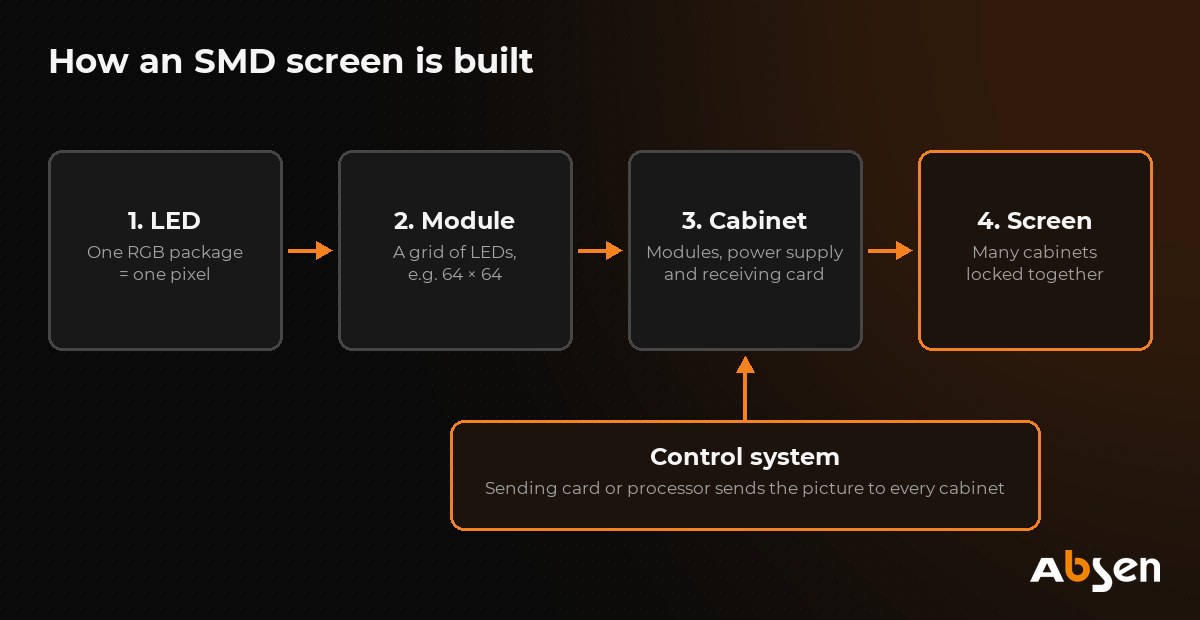
Because the screen is modular, you can build almost any size. You can also replace one faulty module without changing the whole screen. Our SMD screen controller guide explains the control side in detail.
Which specs matter most?
Most quotations list ten or more specs. These six decide most of the picture quality and the price.
| Spec | What it means | What to look for |
|---|---|---|
| Pixel pitch (P) | Distance between two pixels, in mm. P2.5 = 2.5 mm | Smaller for close viewing, larger for far viewing |
| Brightness (nits) | How much light the screen gives out | Indoor about 600 to 1,500 nits. Outdoor in sunlight 5,000 nits or more |
| Refresh rate (Hz) | How many times per second the image is redrawn | 3,840 Hz or higher if the screen will be filmed |
| Grey scale (bit) | How many shades each colour can show | 14 to 16 bit gives smooth dark scenes |
| IP rating | Protection against dust and water | IP65 on the front for outdoor use |
| Cabinet size and weight | Size of each panel block | Light cabinets for rental, fixed cabinets for permanent installs |
Pixel pitch is the spec people get wrong most often. Our pixel pitch guide shows which P value suits which viewing distance.
Brightness is measured in nits. A nit is one candela per square metre (what a nit is). A screen that is too dim washes out in daylight. A screen that is too bright indoors tires the eyes and wastes power.
IP rating is a two-digit code. The first digit is dust protection and the second is water protection. IP65 means dust-tight and protected against water jets (IP code explained).
SMD vs DIP vs COB: what is the difference?
| DIP | SMD | COB | |
|---|---|---|---|
| How the LED is fitted | Legs through the board | Soldered flat on the board | Bare chips bonded to the board, then sealed |
| Typical pixel pitch | P10 and larger | About P1.5 to P10 | About P0.9 to P1.9 |
| Main use today | Old outdoor signs | Indoor, outdoor and rental screens | Close-view fine-pitch walls |
| Surface | Exposed LEDs | Exposed LED packages | Flat, sealed surface |
SMD covers most of the market. COB is newer and is used where people sit very close, such as boardrooms and control rooms. Read COB vs SMD explained for a deeper comparison.
Where are SMD screens used in Pakistan?
- Roadside billboards and building fronts: high-brightness outdoor screens. See our outdoor LED billboard guide.
- Shops, malls and showrooms: window displays and in-store screens. See the shop SMD screen guide.
- Weddings, concerts and corporate events: rental screens behind the stage. See SMD screens for wedding halls.
- Offices, control rooms and auditoriums: fine-pitch indoor video walls.
- Stadiums: perimeter boards and big scoreboards.
How do you choose the right SMD screen?
Work through these questions in order. Each one links to a detailed guide.
- Indoor or outdoor? This sets the brightness and IP rating. Read indoor vs outdoor SMD screen.
- How far will people stand? This sets the pixel pitch. Read the pixel pitch guide.
- How big should it be? This sets the cabinet count and resolution. Read the SMD screen size guide.
- Rent or buy? Read should you rent or buy an SMD screen.
- How much power will it use? Read SMD screen power consumption.
- What will it cost? Read SMD screen price in Pakistan.
- How will you look after it? Read SMD screen maintenance.
Not sure whether you need an SMD screen at all? Compare it with the alternatives in LED video wall vs LCD video wall vs projector.
Is a branded SMD screen worth it?
Two screens with the same pixel pitch can look very different after a year. Cheap unbranded modules often come from mixed production batches. Over time you may see uneven colours, dead pixels and spare modules that do not match.
A branded screen comes from one factory with calibrated cabinets, a written warranty and matching spare parts. Absen has made SMD screens since 2001. In Pakistan, Absen screens are supplied by Irfan Corporation, the authorised Absen distributor, with offices in Karachi and Islamabad. You can see the full range on our Absen products page, or read how to check an original Absen screen.
Frequently asked questions
SMD stands for Surface-Mounted Device. It means the LED is soldered flat onto the surface of the circuit board instead of having legs that go through it.
An SMD screen is one type of LED screen. “LED screen” is the wider term. It also covers DIP and COB screens, which fit the LEDs to the board in a different way.
Yes, if it is built for outdoor use. Look for an IP65 front, high brightness (usually 5,000 nits or more for direct sun) and a sealed power box.
It depends on the brand, the heat it runs in and how many hours a day it runs. Absen rates its A25 outdoor series for a service life of up to 10 years. Good ventilation and stable power help any screen last longer.
There is no single best pitch. For a meeting room where people sit 2 to 3 metres away, P1.5 to P2.5 works well. For a roadside billboard seen from 10 metres or more, P6 to P10 is usually enough.
About this guide: Written by the Absen Pakistan team at Irfan Corporation, the authorised Absen distributor in Pakistan, with offices in Karachi and Islamabad. Product details come from Absen’s official specifications. Last updated: 19 October 2026.
Related Absen products: Absen KLCOB V2 Micro LED display · Absen KLCOB COB LED display · Absen MC indoor SMD screen